
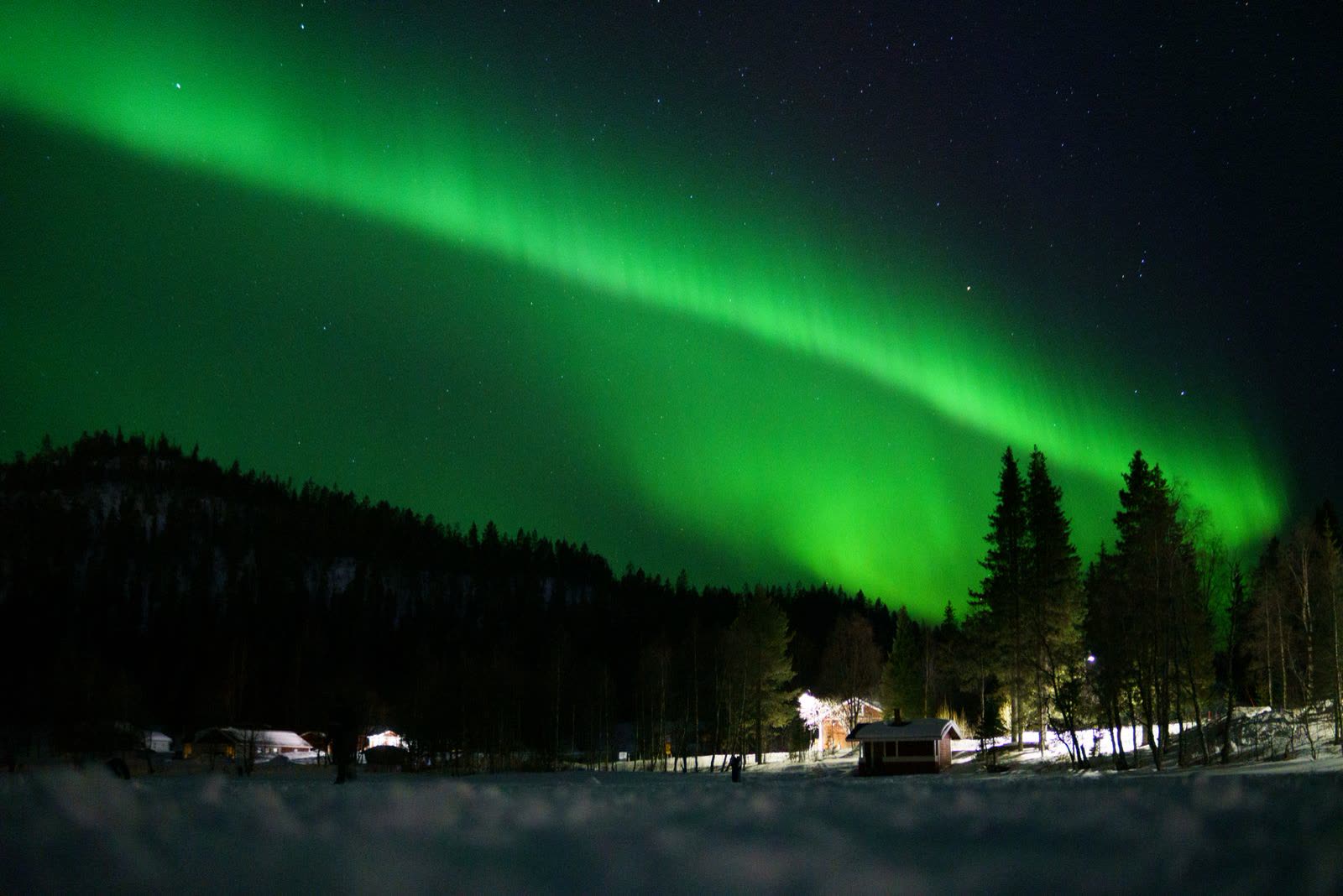
Winter is not one season to chase, but two, and they reward almost opposite instincts. One is about certainty: snow that can be trusted months in advance because altitude and glacier ice put it beyond the reach of an unlucky week of warm weather. The other is about patience and honesty: a natural phenomenon that no operator, however skilled, can promise on any given night, and that only becomes more enjoyable once that fact is accepted rather than fought.
The alpine winter
Snow reliability in the Alps comes down largely to altitude. Resorts with skiing above roughly 2,000 to 3,000 metres, and especially those with glacier access, hold their snow through periods that leave lower resorts patchy or closed, because cold temperatures at height slow the melt regardless of what is happening in the valley. Val Thorens, the highest resort village in Europe with most of its terrain above 2,000 metres, and Zermatt, with skiing on the Matterhorn glacier reaching above 3,000 metres, are both built almost entirely on this principle, which is why they anchor most serious conversations about snow-sure skiing. Glacier terrain matters most precisely at the edges of the season, in late November or in April and beyond, when it can still be skied while lower slopes elsewhere have already lost their cover.
Altitude also decides the character of a day on the mountain rather than just its likelihood. First tracks, the run made on freshly groomed or freshly fallen snow before anyone else has touched it, are a function of being on the lift at opening rather than any particular resort, but they are far more reliably available where the snowpack itself is reliable. A chalet chosen at altitude, close to a lift rather than a village centre, tends to buy back exactly the early minutes that first tracks depend on.
The choice of resort also carries a question of character worth weighing alongside the snow report. Some of the highest, most reliably snow-sure resorts were purpose-built in the mid-twentieth century for efficient, direct access to the lifts, and favour function over old-world charm as a result. Others manage to combine genuine altitude with a village core of stone farmhouses and a centuries-old church, giving the same dependable snow a warmer, more atmospheric base to return to once the lifts close. Neither approach is wrong; it depends on whether the days on the mountain or the evenings in the village matter more to the particular trip being planned.
One reward is certainty, snow that can be trusted months ahead. The other is patience: a phenomenon no one can promise on any given night.
The far-northern winter
Lapland offers a different kind of winter entirely, built around darkness rather than snow depth. The aurora season runs broadly from late August to mid-April, and within it two periods stand out for reasons that are genuinely measurable rather than folklore: geomagnetic activity rises around the spring and autumn equinoxes, a well-documented pattern known as the Russell-McPherron effect, caused by the way the Earth's and the sun's magnetic fields align more favourably for energy transfer at those two points in the year. September and March are, statistically, among the strongest windows for activity.
Midwinter offers something different again rather than better: in the far north of Swedish and Finnish Lapland, December brings the polar night, with the sun failing to rise at all and up to twenty hours of usable darkness a day. That darkness does not create the aurora, but it removes the one obstacle daylight always imposes, and it pairs the phenomenon with a snow-covered, still landscape that many travellers find just as memorable as the lights themselves.
Reading the aurora honestly
None of this amounts to a guarantee, and any account that implies otherwise is not being straight with you. The aurora depends on solar activity that fluctuates night to night, and on clear skies that no season can assure. What the equinox and midwinter periods offer is genuinely better odds, not certainty, and a well-chosen base, away from light pollution, with clear sightlines and enough nights allocated to allow for at least one clouded-over evening, does more to improve the chances than any single date on the calendar.
Ready to turn reading into travelling?
Begin an enquiry