
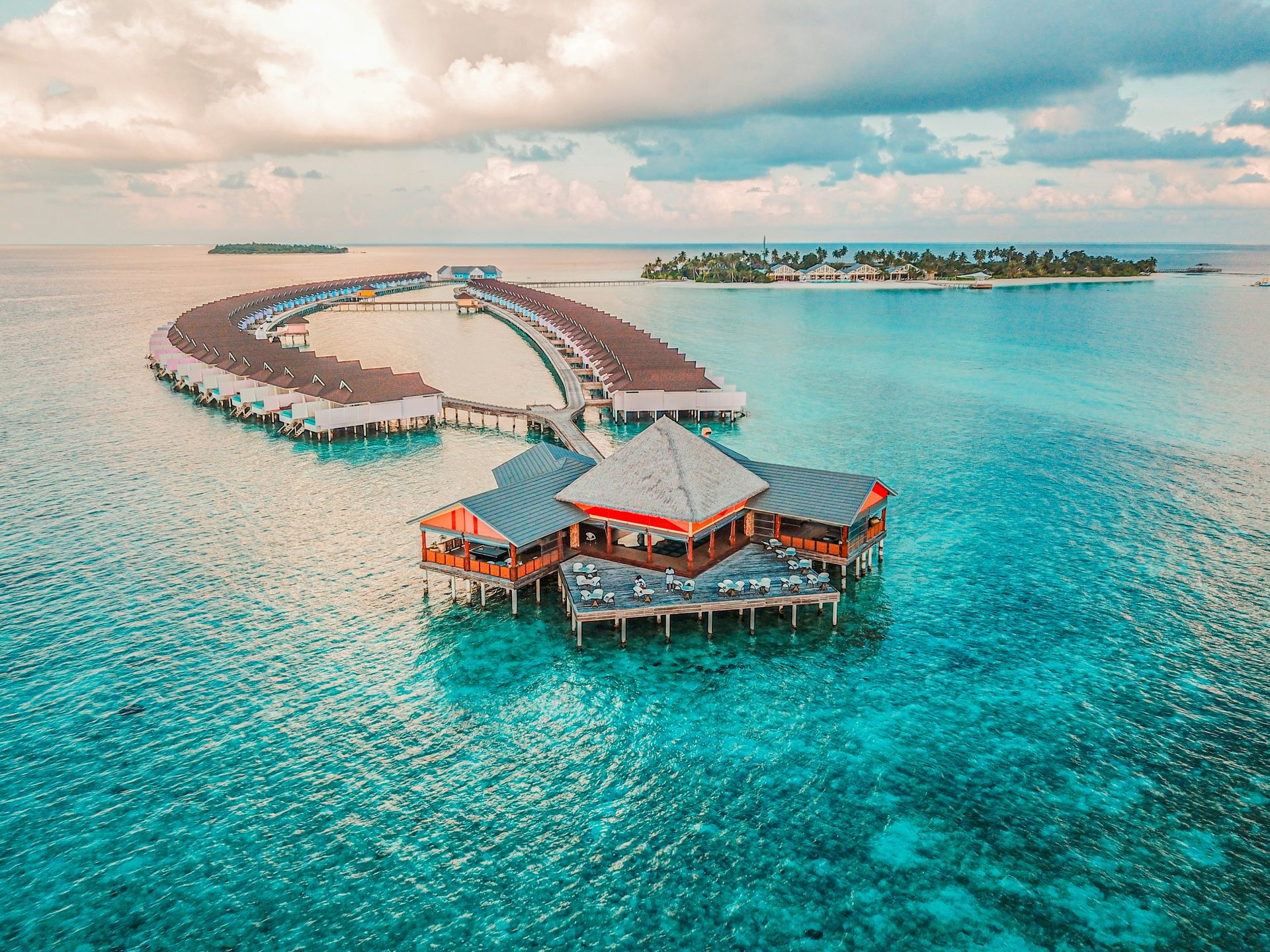
The overwater villa is younger than it looks. It was not born in the Maldives, where it now feels indigenous, but in French Polynesia, in the lagoon at Raiatea, where three American hoteliers ran out of beach in 1967 and put their guest huts on stilts over the water instead. The idea reached Bora Bora three years later, when the island's own first overwater rooms opened and became the postcard image the rest of the world would go on to copy. Knowing this matters less as trivia than as a reminder: the overwater villa was a solution to a specific piece of geography, and geography is still what separates one destination from another today.
Two lagoons, two characters
The Maldives is not one lagoon but hundreds, spread across coral atolls in the Indian Ocean, each resort typically occupying its own small island with its own reef and its own stretch of shallow, glassy water. The effect is intimacy: a private-feeling lagoon, often calm enough to wade in from the villa steps, with the wider ocean visible but held at a distance by the reef.
Bora Bora offers something more theatrical. Its lagoon is singular and vast, wrapped around the island itself, with the peak of Mount Otemanu rising at its centre as a fixed, unmissable backdrop from almost every villa. Where the Maldives gives a sense of being tucked away on your own patch of sea, Bora Bora gives a view, the same view that made the overwater villa famous in the first place.
Fiji is different again, and for a reason worth understanding before it disappoints anyone. Most Fijian land is owned communally under indigenous iTaukei title, leased rather than sold, and this has kept large-scale overwater construction rare. Fiji's overwater villas exist, but sparingly, which means travellers drawn to the format specifically should treat the Maldives and French Polynesia as the two real centres of the genre, and Fiji as a beach-and-reef destination that happens to offer a handful of exceptions.
The journey itself
This is where the two leading destinations diverge most sharply, and where a lot of disappointment is quietly manufactured by people who skip past it. A journey to the Maldives typically means a long-haul flight into Velana International Airport, followed by a domestic transfer: a speedboat, running day and night, for resorts within roughly an hour of Malé, or a seaplane for those further out, which flies only in daylight and stops taking off in the mid-afternoon. Arrive on a late flight and a seaplane transfer may mean an overnight in Malé before reaching the villa at all.
Bora Bora asks more of the traveller. It usually means a long-haul flight to Tahiti, an onward flight of roughly an hour to Bora Bora's small airport on its own motu, and a final boat transfer to the resort. It is a full day of travel stacked on top of the long-haul sector, and it should be budgeted as such rather than treated as a footnote.
The overwater villa was a solution to a specific piece of geography, and geography is still what separates one destination from another.
Reading the seasons honestly
The Maldives runs on two monsoons. The dry, northeast monsoon from December to April brings the calm seas and reliable sunshine most people picture, and is the busiest and most expensive stretch of the year. The wet, southwest monsoon from May to November brings short, heavy afternoon showers and stronger winds rather than continuous rain, and April and November sit as genuine shoulder months worth considering.
French Polynesia's dry season runs roughly April to October, with July and August the driest stretch and May and September the most balanced choice of light crowds and settled weather. November to April is wetter and warmer, and carries a small but real cyclone risk, most notably in December and January.
Who it suits
Bora Bora, with its longer journey, its small number of resorts and its atmosphere built almost entirely around romance, tends to suit a honeymoon or an anniversary far better than a family trip. The Maldives has developed in the other direction: many resorts now offer kids' clubs, shallow lagoons safe for young swimmers, and villas designed with families in mind, though an overwater villa's open deck and direct drop into the lagoon is worth thinking through carefully for a family with a child under about eight, where a beach villa often makes the more relaxed choice. For a honeymoon without children in the equation, either destination rewards the investment; the decision then comes down to whether you want intimacy or spectacle, and how much of the trip you are willing to spend simply getting there.
Ready to turn reading into travelling?
Begin an enquiry